ChatGPT recommends one brand. Is it yours?
Sagentel replays the questions your customers ask, records the answers, and shows the pages behind them.




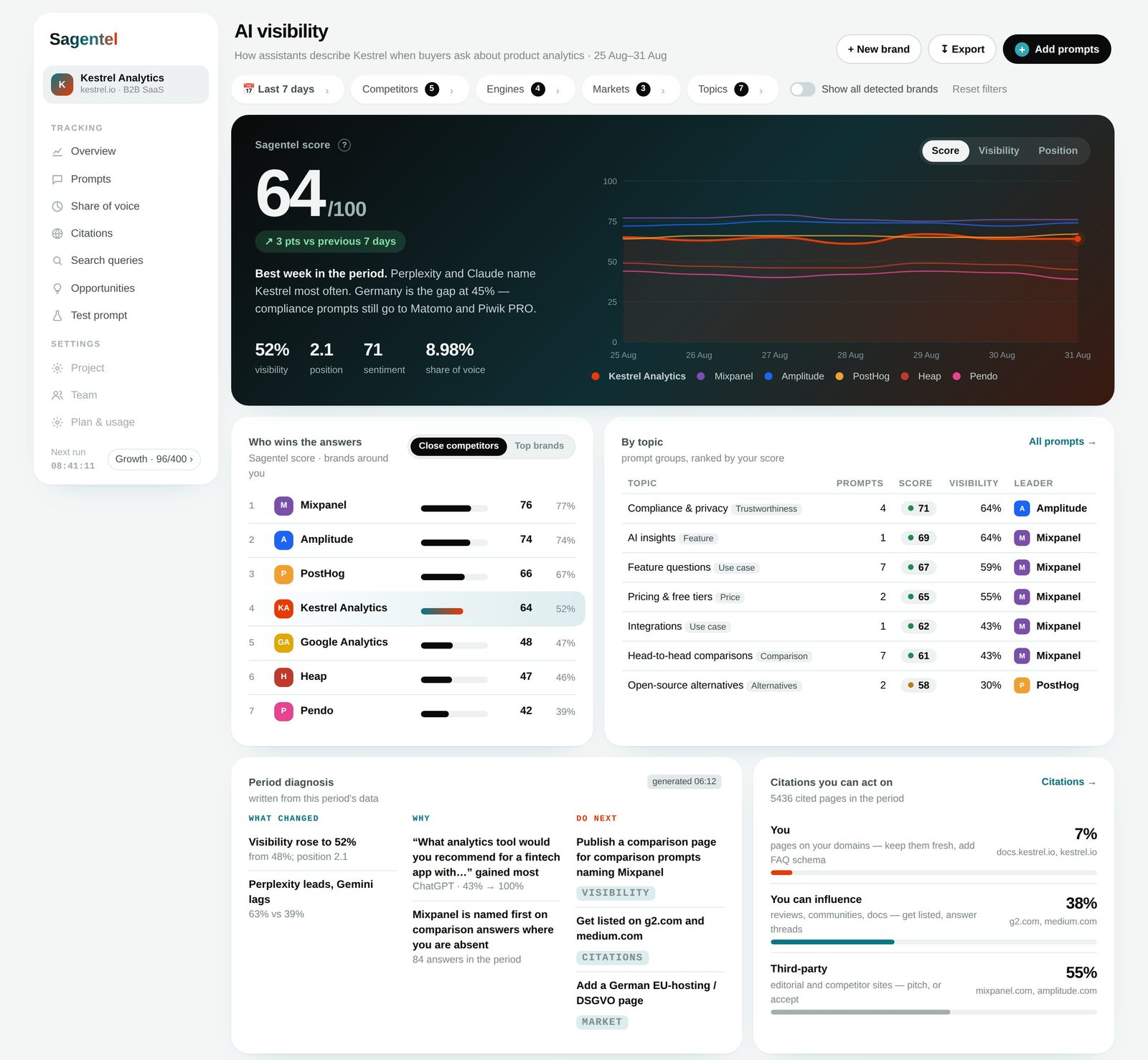
Being named and being chosen are two different outcomes
Counting appearances tells you almost nothing on its own. We keep four readings apart, because each one points at a different piece of work.
What the model reaches for before it answers
Nothing here is a ranking factor in the old sense. An answer is assembled from material the model can locate, believe and quote — and each of those is something your team can change.
Built for the people who own the number
One reading per engine and per question cluster, with the missing evidence listed underneath it. No manual collation before the meeting.
Keep every language and product family on its own track, and catch a wrong price or discontinued model while it is still only the model saying it.
Separate workspaces per client, question sets that stay fixed between runs, and a before-and-after you can defend line by line.
Questions we get asked
What are you actually measuring?
Four readings, deliberately kept apart: how often your name reaches the final answer, where it lands inside it, the language wrapped around it, and the pages quoted to justify it. Appearing on the back of a rival's article is a different problem from not appearing at all, and the remedy is different too.
Which questions are worth watching first?
The ones where a decision gets made: what to buy, which of two to pick, what to use instead, what it costs, and anything pairing you with a rival. Around forty per category is enough to read a trend; widen the set once the obvious holes are closed.
Can any of this be changed?
Not by editing the answer, but yes by changing what it is built from. In practice one of three things is holding you back — thin coverage of the question, nobody outside your site vouching for you, or a name the model cannot pin down. Measurement's job is to say which one.
We rank well in Google. Isn't that the same thing?
It helps, and it guarantees nothing. Ahrefs found 28.3% of the pages ChatGPT cites most have no measurable organic visibility in Google at all. We routinely see small specialists appear more often than the category leader, because one channel rewards a ranked page and the other rewards a quotable one.
How stable are the answers?
Less stable than most teams expect. Wording and quoted pages drift as models refresh and new material is indexed, so a single audit is out of date within weeks. We re-run the same question set on a schedule and report the movement rather than the moment.
What does the first month look like?
Run one: a baseline across your starter question set, the names appearing in your place, and the pages behind those answers. Run two, a week later, shows what moved on its own. From there you get an ordered list of fixes, and a working session with a strategist if you want help sequencing it.
Somebody asked about your category this morning.
One domain, one question set, first results the same day — appearance rate, who filled your slot, and the pages that decided it.