Perplexity answers with citations. Are any of them yours?
Sagentel runs your buyers' questions through Perplexity, records who gets named, and lists every link it footnoted.




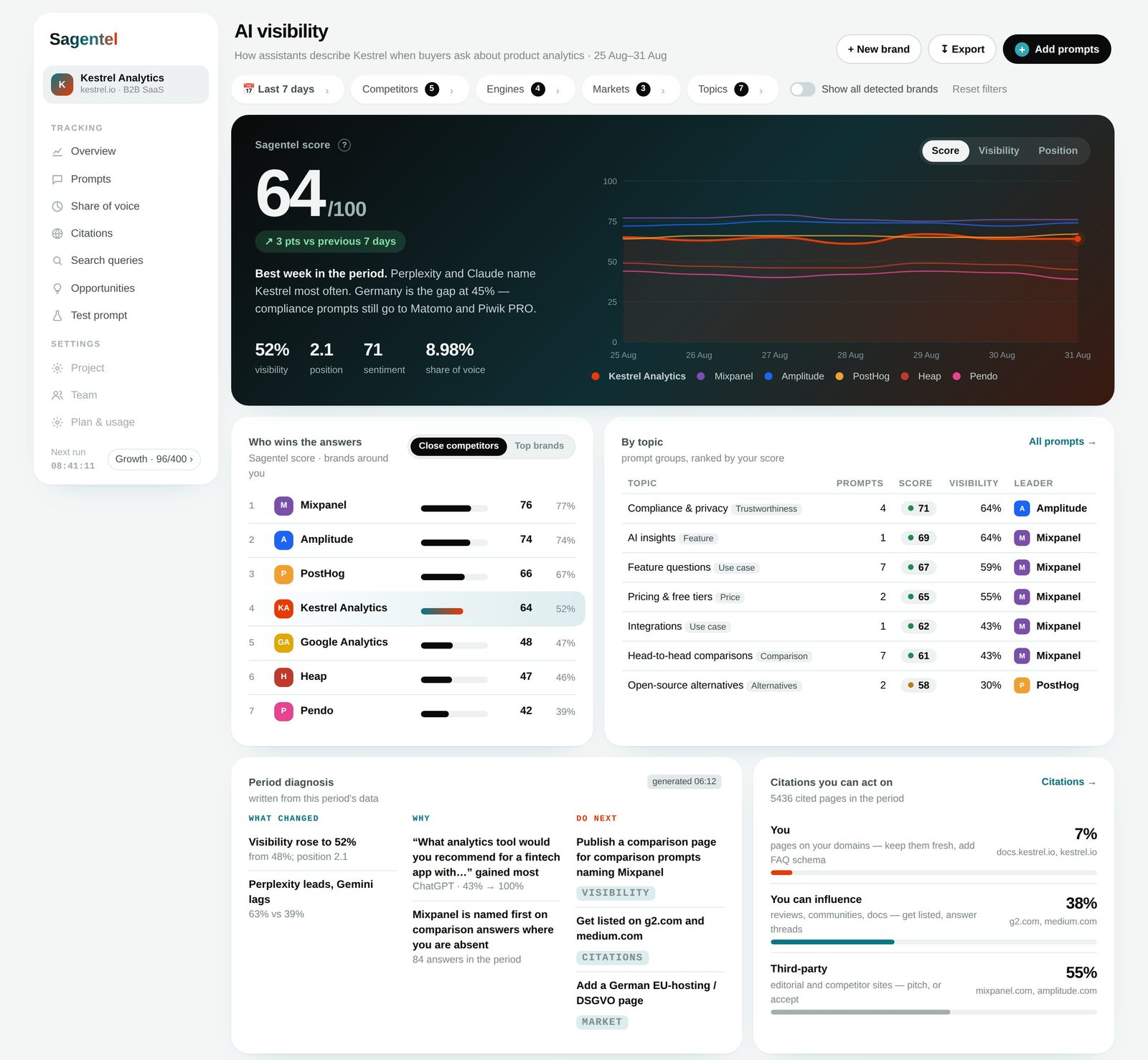
On Perplexity, the link list is the answer
Every reply shows its working, which makes Perplexity the most legible engine to optimise for — provided you read four things separately.
What Perplexity looks at before it writes
Perplexity retrieves live pages, then writes from them. That makes the work concrete: get crawled, get quoted, get corroborated, stay current.
Built for the people who own the number
One citation rate per question cluster, with the domains you are missing from listed underneath it. No manual collation before the meeting.
Keep every language and product family on its own track, and catch a wrong price or a discontinued model while it is still only a cited page repeating it.
Separate workspaces per client, question sets fixed between runs, and a citation-level before-and-after you can defend line by line.
Questions we get asked
What are you actually measuring?
Four readings, deliberately kept apart: how often one of your pages is cited, whether you are named in the prose as well as linked, the language used about you, and which other domains keep winning the citation. Being described from a rival's page is a different problem from being absent, and the fix differs too.
Which questions are worth watching first?
The ones where a decision gets made: what to buy, which of two to pick, what to use instead, what it costs, and anything pairing you with a rival. Around forty per category reads a trend reliably. Perplexity also expands into follow-up questions, so we track the obvious second question too.
Can any of this be changed?
More directly than on other engines, because the sources are printed. If a page you can influence is being cited, the wording is fixable. If somebody else's page owns the citation, the work is to earn a place on it or publish something better.
Does our Google ranking carry over?
Partly. Perplexity leans on its own retrieval and heavily on community and review sources, so a well-ranked product page frequently loses the citation to a forum thread discussing it. Overlap exists; dependence does not.
How stable are the answers?
Less stable than elsewhere. Because retrieval happens live, the same question can cite different pages within days. That cuts both ways: changes you make show up faster here than on any other engine.
What does the first month look like?
Run one: a baseline citation rate across your starter question set, the domains cited in your place, and where you are named without being linked. Run two, a week later, separates real gaps from noise. From there you get an ordered list of fixes, and a working session with a strategist if you want help sequencing it.
Perplexity already printed its sources.
One domain, one question set, first results the same day — citation rate, the domains cited instead of you, and what it would take to displace them.